Table of Contents
Walk into any busy bar or nightclub on a Friday night and you will immediately sense the energy music pumping, crowds surging, drinks flowing, and laughter filling every corner. Bars and nightclubs are places where people come to unwind, celebrate, and connect. They are built for fun.
But behind every great night out is an invisible layer of risk management that most patrons never notice and that is exactly the point. A well-run establishment keeps the good times rolling precisely because its bartenders and security staff are trained, prepared, and equipped to handle anything that comes their way.
The nightlife industry is one of the most legally exposed sectors in hospitality. Alcohol service, by its very nature, introduces risks that other businesses never face. When something goes wrong an overserved guest causes an accident, a fight breaks out, a minor is served the consequences are swift and severe. We are talking about liquor license suspensions, civil lawsuits, criminal charges, and financial losses that can permanently close an establishment.
This is why security training for bartenders and security professionals is not a luxury or a box-checking exercise. It is one of the most valuable operational investments a bar or nightclub owner can make. And for staff working the floor, the bar, or the door, proper training is the difference between handling a situation confidently and making a costly mistake.
At Serving Alcohol Inc., we have spent years providing state-approved responsible alcohol training certifications to bartenders, servers, managers, and security professionals across the country. We understand what it takes to run a safe, compliant, and profitable alcohol-serving establishment. In this comprehensive guide, we will break down every dimension of security training for nightlife professionals what it covers, why it matters, what it costs, and how to get started.
Part 1: Why Security Training Is Non-Negotiable in Today’s Bar and Nightclub Industry
The Legal Landscape Has Changed
Dram shop liability laws exist in most U.S. states. Under these laws, a bar or restaurant that serves alcohol to a visibly intoxicated person or to a minor can be held legally responsible for any harm that person causes afterward. This means that if an overserved customer gets into a car accident and injures someone on the way home, the establishment that served them last could face a civil lawsuit.
The numbers are staggering. Defending a single liquor liability lawsuit can cost tens of thousands of dollars in legal fees, even if the establishment ultimately wins. If they lose, settlements and judgments can reach into the hundreds of thousands or beyond. Add potential criminal charges against individual staff members, and the stakes become very personal very quickly.
The good news is that trained staff dramatically reduces this risk. Bartenders who know how to recognize intoxication and legally refuse service, doormen who can confidently identify fake IDs, and security professionals who can de-escalate conflicts before they become violent are the most effective tools any establishment has against liability exposure.
Regulators and insurance carriers have taken notice. Many states now offer reduced penalties or favorable treatment to establishments whose staff have completed state-approved responsible beverage service training. And insurance companies including many that specialize in hospitality coverage actively offer premium discounts to businesses that invest in certified training programs.
The Risk Is Real and Constant
Bars and nightclubs deal with a unique combination of risk factors that virtually no other business faces in the same concentration:
Alcohol impairs judgment. Customers who arrive sober may become intoxicated over the course of the evening. Their behavior changes, their coordination suffers, and their willingness to engage in risky behavior increases. Staff must track dozens of guests simultaneously and make real-time judgments about who has had too much.
Large crowds create friction. When people are packed into tight spaces, minor annoyances can escalate into confrontations. A bump into someone’s drink, an argument over a table, or a misunderstanding between strangers can quickly become a physical altercation if staff are not watching and do not intervene correctly.
Late-night environments attract a diverse crowd. Establishments open late draw people at various stages of their evening some arriving fresh, others already drunk from previous venues. Identifying who is at risk requires sharp awareness and consistent training.
Fake IDs are increasingly sophisticated. The market for fake identification has evolved dramatically. Modern fake IDs can be extraordinarily convincing. Without specific, up-to-date training on what to look for, even experienced staff can be fooled.
Emergencies happen without warning. A customer collapses. Someone has a seizure. A fight breaks out. A fire alarm sounds. In these moments, trained staff save lives. Untrained staff panic.
Part 2: What Comprehensive Security Training Actually Covers
Responsible Alcohol Service Certification
The foundation of any bar or nightclub security training program is responsible beverage service, often referred to as RBS training or alcohol server certification. This training is the core of what Serving Alcohol Inc. provides through our state-approved certification programs.
Responsible alcohol service training covers the legal, practical, and ethical dimensions of serving alcohol. Here is what a complete program addresses:
Understanding alcohol and its effects on the body. Good service decisions start with knowledge. Bartenders and servers need to understand how alcohol is metabolized, why different people have different tolerances, and how factors like body weight, gender, food consumption, and medications affect intoxication levels. This is not common knowledge it is teachable science that dramatically improves a server’s ability to assess a customer’s condition accurately.
Recognizing signs of intoxication. What does “visibly intoxicated” actually look like? It is not always slurred speech and stumbling. Trained staff learn to spot early, middle, and late signs of intoxication changes in behavior, coordination, speech patterns, and demeanor. The earlier these signs are caught, the easier it is to intervene.
Legally and tactfully refusing service. Refusing service to a customer who wants another drink is one of the most difficult moments a bartender faces. Without training, servers often avoid it entirely with severe consequences. Proper training gives staff the words, the body language, and the confidence to decline service in a way that de-escalates rather than provokes, protects the customer’s dignity, and holds up legally.
Understanding dram shop liability. Staff who understand the legal consequences of overservice take that responsibility more seriously. When a bartender knows that their decision to pour one more drink could make them and their employer personally liable for a crash on the highway an hour later, they see the weight of the moment differently.
Age verification and checking IDs. Responsible service training includes thorough instruction on how to properly check identification, what documents are acceptable in your state, and what to look for when evaluating whether an ID is genuine.
Intervention strategies. What happens when a customer is already clearly intoxicated? Training covers how to approach the situation, how to communicate with the customer and their companions, how to arrange safe transportation, and how to document the incident.
Fake ID Detection Training
Preventing underage drinking is both a legal obligation and a public safety responsibility. Establishments caught serving minors face serious consequences fines, license suspension or revocation, and potential criminal charges for the individual server.
Modern fake ID detection is a skill set in itself. Training programs teach staff to:
- Understand the security features of valid state-issued driver’s licenses and ID cards, including holograms, microprinting, UV-reactive ink, and magnetic stripe data.
- Know what to look for in terms of physical feel, photo alignment, font consistency, and lamination quality.
- Use ID scanning technology and understand its limitations.
- Recognize common patterns used in specific state IDs that are frequently counterfeited.
- Handle situations where a patron becomes aggressive after their ID is questioned.
- Properly document refusals of entry or service.
The confidence that comes from proper training is itself a deterrent. Patrons attempting to use fake identification can often tell when staff are genuinely knowledgeable versus going through the motions. A trained door staff that projects competence and certainty is much more likely to deter attempts before they even begin.
Conflict De-Escalation and Crisis Management
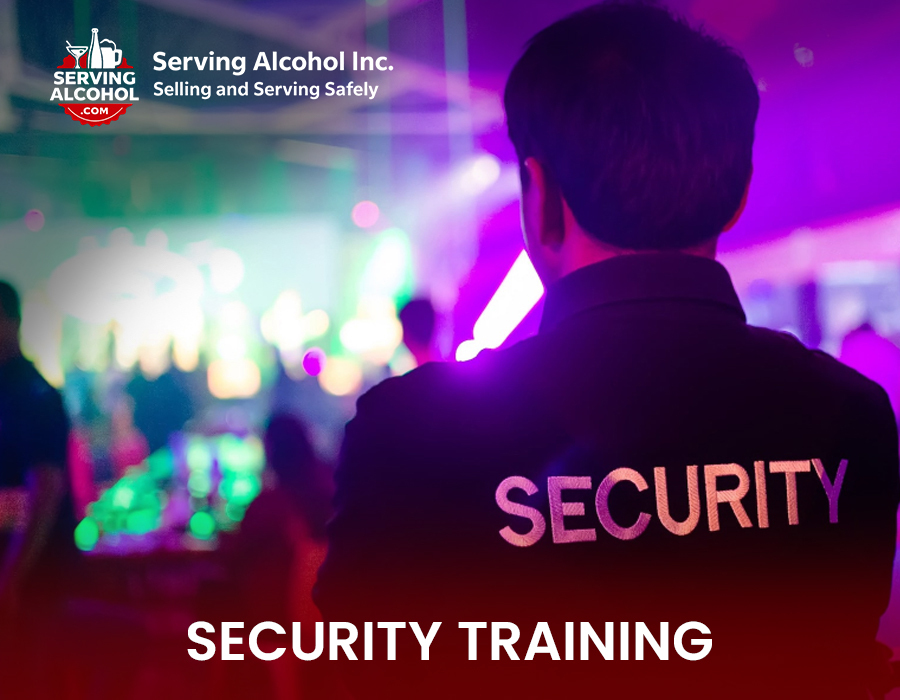
Security professionals in nightlife environments face a fundamentally different set of challenges than security in most other industries. They are dealing with impaired people in emotionally charged environments, often in tight physical spaces, with loud music making communication difficult.
De-escalation training is the cornerstone of effective nightlife security, and it is also highly relevant for bartenders who are often the first to notice a brewing conflict. A well-trained staff member can frequently resolve a situation with words and positioning alone, long before it requires any physical intervention.
Verbal communication under pressure. The right words, tone, and pacing can dramatically change the trajectory of a confrontation. Training teaches staff to use calm, clear, non-threatening language even when they are feeling stressed or threatened themselves. Simple techniques acknowledging the other person’s frustration, offering choices rather than ultimatums, using names when known make a measurable difference.
Non-verbal communication and body language. What you do with your body communicates as much as what you say. Training covers how to position yourself to appear non-threatening, how to maintain appropriate distance, how to avoid postures that escalate tension, and how to use physical presence to calm rather than provoke.
Situational awareness and early intervention. Most conflicts do not erupt without warning. There are almost always early indicators raised voices, pointed fingers, people moving toward each other, glasses being set down hard. Trained staff learn to scan the room constantly and identify these signs early enough to intervene before a situation becomes critical.
Team communication. Security professionals and bartenders need to be able to communicate with each other quickly and discreetly. Training establishes protocols for how staff signal one another, how backup is requested, and how to present a coordinated response that does not escalate the situation further.
Documentation and reporting. After any incident, proper documentation protects both the establishment and its staff. Training covers what information needs to be captured, how incident reports should be written, and why this documentation matters for insurance, legal defense, and future training.
Emergency Preparedness
Bars and nightclubs can face medical emergencies, fires, severe weather events, and in an increasingly concerning trend active threat situations. Staff who have never thought about what to do in a crisis will freeze. Trained staff act.
Emergency preparedness training for bar and nightclub staff includes:
Medical emergencies. Alcohol-related medical events are common in nightlife environments. Staff need to know how to recognize when someone has consumed too much alcohol and needs emergency medical help, how to respond when someone loses consciousness, and how to handle drug-related emergencies. Basic first aid and CPR certification complement this training significantly.
Fire safety and evacuation. Crowded spaces with limited exits present serious fire risks. Every staff member should know the evacuation plan, their assigned responsibilities during an evacuation, and how to move crowds calmly and quickly.
Active threat response. While no one wants to think about this, bar and nightclub owners and their staff need to have a plan. Awareness training that covers how to recognize warning signs, how to respond if a threat materializes, and how to communicate with law enforcement is increasingly considered a baseline responsibility for nightlife establishments.
Calling for help effectively. In a crisis, the quality of a 911 call matters. Training teaches staff what information to provide, how to stay calm, and how to keep communication with emergency services clear and useful.
Part 3: The Specific Benefits for Bartenders
Bartenders occupy a unique position in the security ecosystem of a bar or nightclub. They have more sustained, close contact with guests than almost anyone else on staff. They are the ones who physically control the flow of alcohol. And they are often the first to sense when something is wrong.
Bartenders as the First Line of Defense
A bartender who understands their legal responsibilities and has practical training in recognizing intoxication is enormously valuable to any establishment. They are in a position to prevent problems that no amount of security muscle can fix after the fact. Once a guest has been over-served to the point of becoming belligerent or incapacitated, the damage is already done. A trained bartender stops it from reaching that point.
Building Confidence and Reducing Staff Stress
One of the most underappreciated benefits of proper training is its effect on staff morale and mental health. Working in a bar or nightclub can be an extraordinarily stressful job. The pace is relentless, the stakes are high, and difficult situations arise without warning. Staff who have not been trained often feel anxious, unsure of themselves, and resentful of the pressure they are under.
Training changes this. When a bartender knows exactly what to look for, what to say, and what to do, they approach their shift with confidence instead of anxiety. They feel supported by their employer. They are more engaged, more effective, and more likely to stay in the job which reduces turnover, one of the most expensive ongoing costs for any hospitality business.
Protecting Your Liquor License
A bartender who serves a minor or who continues serving a visibly intoxicated person puts the establishment’s liquor license at risk. Losing that license is a business-ending event. The liquor license is the heartbeat of a bar or nightclub without it, there is no business. The training investment that prevents a single serving violation more than pays for itself in the value of the license it protects.
Tips, Service Quality, and Reputation
A somewhat overlooked benefit of responsible beverage service training is the impact it has on service quality and customer satisfaction. Trained bartenders understand how to pace drinks for guests, how to suggest food and water alongside alcohol, and how to engage guests in a way that keeps them comfortable and enjoying themselves without pushing them toward overservice. The result is often better tips, better reviews, and a more loyal customer base.
Part 4: The Specific Benefits for Security Professionals
Security staff in bars and nightclubs take on one of the most physically and psychologically demanding roles in the hospitality industry. They work late hours, deal with impaired and sometimes aggressive individuals, and are expected to make split-second decisions in high-pressure situations. Without proper training, they are set up to fail.
From Muscle to Professionalism
The days of hiring the biggest person in the room and calling them security are long over or at least, they should be. Modern nightlife security professionals are expected to be intelligent, trained, and capable of handling situations through communication and procedure first, with physical intervention only as a last resort. This professionalism is not just better for guests and staff it massively reduces the establishment’s liability exposure.
An untrained security person who physically escalates a situation that could have been resolved verbally creates serious legal risk. A trained security professional who follows established de-escalation protocols and only uses force when genuinely necessary is a legal asset.
Understanding the Legal Limits of Security
Security professionals need to understand what they are and are not legally authorized to do. The law around detainment, use of force, and citizen’s arrest varies significantly by state, and security staff who overstep these boundaries even with good intentions create serious liability for themselves and the establishment.
Training covers these legal boundaries in practical, real-world terms. Security professionals learn when they can intervene, how much force is legally justifiable in what circumstances, and how to document their actions to protect themselves legally.
Working with Law Enforcement
In situations that require police involvement, trained security professionals know how to work with law enforcement effectively. This includes how to communicate what has happened, how to preserve evidence and witnesses, and how to support a police response rather than interfering with it. Security staff who have training in this area can make a significant difference in how quickly and effectively law enforcement can resolve a situation.
Part 5: The Cost-Benefit Case for Bar and Nightclub Owners
Let us be direct about the business case, because we know that for many bar and nightclub owners, the question ultimately comes down to numbers.
What Training Costs
Responsible alcohol service certification through programs like those offered by Serving Alcohol Inc. is among the most affordable professional certifications available. State-approved online courses typically range from $10 to $30 per employee, with group pricing available for business accounts. More comprehensive training programs that include security-specific elements, de-escalation training, and management certification run somewhat higher but are still far below what most business owners expect.
For a bar with 15 staff members, a complete training program including alcohol certification for all servers and bartenders, plus enhanced security training for door and floor staff might represent a total annual investment of $500 to $2,000. For larger operations or those in states with mandatory certification requirements, the numbers scale accordingly, but the per-employee cost remains highly manageable.
Serving Alcohol Inc. makes this even easier through our Business Account platform, which allows owners and managers to purchase courses in bulk, track employee completion, and access digital certificates all in one place.
What a Single Incident Costs
The contrast is sharp. Consider these realistic cost scenarios from the industry:
A single liquor liability lawsuit, even one that is ultimately won, typically costs $15,000 to $50,000 in legal fees. If the case goes to trial and the establishment loses, settlements and judgments commonly range from $75,000 to well over $250,000.
A citation for serving a minor can result in a fine of $500 to $10,000 per offense, depending on the state, plus a mandatory suspension of the liquor license. Even a two-week closure for a busy bar or nightclub represents tens of thousands of dollars in lost revenue.
An incident of violence on the premises particularly one where a security person is found to have used excessive force, or where a fight escalated because staff did not intervene effectively can generate both criminal proceedings and civil claims simultaneously.
A single alcohol-related driving fatality traced back to an establishment can result in a settlement in the millions of dollars.
The Insurance Discount Factor
Insurance companies that specialize in hospitality and liquor liability coverage understand this risk calculus very well. Many of them actively reward establishments that invest in certified training programs. Serving Alcohol Inc. is trusted by liability insurance carriers nationwide, and our training certifications are recognized by insurers who offer premium discounts for trained staff.
For a business paying $10,000 to $20,000 annually in liquor liability and general liability insurance a common range for a mid-sized bar or nightclub even a 10% discount represents $1,000 to $2,000 in annual savings. That alone can offset the entire training investment.
The Return on Investment Timeline
Unlike many business investments, training delivers a return that can be measured in weeks or months rather than years. The prevention of even a single significant incident justifies years of training costs. The insurance savings often cover the training cost within the first year. The improvement in staff confidence and retention reduces recruitment and onboarding costs that can easily run $3,000 to $5,000 per employee.
And perhaps most valuable of all a reputation for being a safe, professionally run establishment attracts more customers, higher-quality staff, and better relationships with local law enforcement and regulatory bodies.
Part 6: Mandatory vs. Voluntary Training — What Your State Requires
The State-by-State Landscape
Alcohol server training requirements vary significantly across the United States. Some states mandate it by law for every individual who sells or serves alcohol commercially. Others make it voluntary but offer meaningful incentives for establishments that invest in it. Still others are somewhere in between, requiring training in certain circumstances or for certain license types.
Here is the important thing to understand: even in states where training is not legally mandated, failing to provide it does not insulate you from liability it exposes you to more of it. Courts and juries in liquor liability cases consistently consider whether staff were trained. An establishment that can demonstrate its staff completed a recognized training program before an incident occurred is in a fundamentally stronger legal position than one that cannot.
Serving Alcohol Inc. offers state-approved certification courses for nearly every state in the country, including Texas TABC certification, California RBS certification, Illinois BASSET, Florida Responsible Vendor training, New York ATAP, and dozens of others. Our courses meet or exceed state requirements and are delivered 100% online, allowing staff to complete training on their own schedule from any device.
States with Mandatory Requirements
Several states require alcohol server certification as a condition of employment or licensure. Texas, for example, requires TABC certification for anyone who sells or serves alcohol. California’s Responsible Beverage Service training became mandatory for servers and managers at on-sale establishments. Oregon requires an OLCC service permit. Illinois requires BASSET certification for certain license types.
In these states, operating without certified staff is not just a risk management failure it is a legal violation that can result in immediate penalties.
The Trend Toward Greater Accountability
The regulatory trend is clearly moving toward greater accountability for alcohol-serving establishments. More states have been strengthening their responsible beverage service requirements in recent years, and this trend is expected to continue. Establishments that build a training culture now will be ahead of compliance requirements that may become mandatory in their state in the coming years.
Part 7: Building a Training Culture in Your Establishment
Training Is Not a One-Time Event
One of the most common mistakes bar and nightclub owners make with training is treating it as a one-time onboarding requirement. New staff get trained, the box gets checked, and the issue is considered handled. This approach misses most of the value that training can deliver.
Building a genuine training culture means integrating responsible service and security practices into the ongoing life of the establishment. This looks like:
Regular refreshers and recertifications. Staff turnover is high in the hospitality industry. Even stable employees benefit from periodic refresher training that reinforces best practices and updates their knowledge on changing regulations or techniques. Serving Alcohol Inc.’s online platform makes this easy courses can be retaken, certifications renewed, and progress tracked across the entire team.
Pre-shift briefings. Taking five minutes before each shift to review any relevant considerations a special event that might bring unusual crowd dynamics, a reminder about checking IDs at the door, a discussion of an incident from the previous weekend keeps safety top of mind without requiring extensive time investment.
Incident review. When something does go wrong even a minor incident reviewing it as a team is an opportunity to learn. What were the early warning signs? At what point could the situation have been de-escalated? What went well, and what would staff do differently?
Recognizing good decisions. When a bartender appropriately refuses service, or when a security professional resolves a conflict without physical escalation, acknowledge it. Building a culture where doing the right thing is recognized and appreciated encourages more of it.
The Role of Management
A training culture starts at the top. Managers and owners who complete the Responsible Alcohol Manager certification available through Serving Alcohol Inc. demonstrate to their staff that they take this seriously. They also become much more effective at supervising and supporting their team in making good decisions.
Managers who have completed their own training are better equipped to conduct effective onboarding, identify staff who need additional support, and create policies and procedures that reflect best practices in responsible service.
Creating Clear Policies and Procedures
Training is most effective when it is supported by clear, written policies that give staff a framework for decision-making. This includes a written alcohol service policy that specifies the standards for what constitutes visible intoxication, when service should be refused, what documentation is required after a refusal, and how incidents should be reported.
Having these policies written down and signed by staff serves multiple purposes. It ensures consistency every bartender and security professional is working from the same playbook. It demonstrates to regulators and insurers that the establishment takes its responsibilities seriously. And it provides clear guidance for staff in ambiguous situations, removing the uncertainty that often leads to poor decisions.
Part 8: Getting Started with Serving Alcohol Inc.
Who We Are
Serving Alcohol Inc. is one of the most trusted and preferred responsible alcohol training providers in the United States. We offer 100% online, state-approved certification courses that allow your staff to train at their own pace from any device computer, phone, or tablet. After completing a course, staff can instantly download their certification card or certificate.
Our courses are recognized by liability insurance carriers nationwide, which means getting your team trained through Serving Alcohol Inc. can directly support your insurance discounts. We hold an A+ rating from the Better Business Bureau, and we serve businesses and professionals across a wide range of industries bars, restaurants, hotels, retail establishments, sports venues, and more.
Business Accounts for Easy Staff Management
We understand that managing training for an entire staff is one more thing on a bar or nightclub owner’s already full plate. Our Business Account platform is designed to make this as simple as possible.
With a Business Account, you can purchase course credits in bulk, assign courses to employees, track who has completed their training, and access all certifications in a single dashboard. When a regulator or insurance carrier asks for proof of training, you have it all in one place. When a new employee joins, you can enroll them immediately without any back-and-forth.
Our Course Offerings
Beyond our core state-approved alcohol server certification courses, Serving Alcohol Inc. offers a range of additional training options relevant to bar and nightclub operations:
Responsible Alcohol Manager Training Designed specifically for managers and supervisors who need to understand their elevated legal responsibilities and how to build and maintain a responsible service culture in their establishment.
Behind the Bar Excellence A professional development course that helps bartenders elevate their craft and their service, including responsible service techniques that protect both customers and the establishment.
Food Handler Training and Food Manager Certification For establishments that serve food alongside alcohol, ensuring your food service staff are equally well-trained.
Food Allergen Awareness Training A critical safety course for any establishment serving food.
Do you want to learn about bartending license
State-Specific Certification
We offer state-approved courses for alcohol server certification in the majority of U.S. states, including all states with mandatory certification requirements. Our courses are regularly updated to reflect changes in state law and regulatory requirements. You can browse our full list of state courses on our website to find the specific certification your staff needs.
Ready to Protect Your Business?Get your bartenders and security staff certified today 100% online, state-approved, and instantly downloadable. Browse State Certification Courses →
Frequently Asked Questions (FAQs)
Q1: Is alcohol server certification required for bartenders and security staff in bars and nightclubs?
It depends on your state. States like Texas (TABC), California (RBS), Illinois (BASSET), Florida (Responsible Vendor), and Oregon (OLCC) have mandatory certification requirements for anyone who sells or serves alcohol commercially. In other states, certification is voluntary but even in those states, having certified staff is one of the strongest legal defenses an establishment can have if a liability claim is ever filed. The trend across the country is clearly moving toward mandatory requirements, so investing in training now puts your establishment ahead of the curve.
Q2: How long does it take to complete an alcohol server certification course?
Most state-approved courses through Serving Alcohol Inc. can be completed in 2 to 4 hours, depending on the state and course format. Our courses are fully self-paced, which means your staff can start and stop as needed and complete the training on any device phone, tablet, or computer. Once the course is finished, staff can instantly download their certification card or certificate. There is no waiting period.
Q3: Do security staff at bars and nightclubs need the same alcohol training as bartenders?
Yes and in many ways, security professionals benefit even more from it. Security staff are responsible for monitoring guest behavior throughout the entire establishment, managing entry, and making judgment calls about who is too intoxicated to be admitted or should be asked to leave. Understanding alcohol’s effects, recognizing intoxication, and knowing how to handle refusals legally and safely is just as critical for a doorman or floor security professional as it is for a bartender. In addition, security staff specifically benefit from de-escalation training and knowledge of the legal limits of their authority.
Q4: Can security training really reduce our insurance premiums?
Yes. Many liability insurance carriers that specialize in hospitality and liquor liability coverage offer meaningful premium discounts to establishments whose staff hold recognized, state-approved certifications. Serving Alcohol Inc. is trusted by liability insurance carriers nationwide, and our certifications are specifically recognized for this purpose. When you set up a Business Account, you can easily provide your insurance carrier with documentation of your entire team’s training status, which can support your discount application.
Q5: What happens if one of my bartenders serves a minor or an already intoxicated person?
The consequences can be severe and layered. Immediately, the establishment may face a citation and fine from the state alcohol control authority. Depending on the severity and the state, the liquor license could be suspended or revoked. If the over-served person subsequently causes harm a car accident, a fight, an injury the establishment can face civil liability under dram shop laws, meaning lawsuits and potentially massive financial judgments. Individual staff members can also face personal legal consequences in some states. Proper training dramatically reduces the likelihood of these events occurring in the first place.
The Investment That Protects Everything
Running a bar or nightclub is a challenging, rewarding, and high-stakes business. You have invested in your space, your brand, your inventory, your relationships with suppliers and customers. All of that is on the line every time a guest walks through your door.
Security training for your bartenders and security professionals is the investment that protects everything else. It protects your liquor license. It protects you from legal liability. It protects your staff from the stress of operating without guidance in high-pressure situations. It protects your customers from harm. And it protects the reputation and profitability you have worked so hard to build.
The math is not complicated. The cost of training is measured in tens of dollars per employee. The cost of what training prevents is measured in tens of thousands of dollars per incident and sometimes in the permanent closure of the business.
Serving Alcohol Inc. is here to make this investment as easy and effective as possible. Our state-approved online courses, our Business Account platform, and our commitment to keeping our training current with the latest regulations and best practices make us the partner of choice for bars, nightclubs, and restaurants across the country.
Your doors are open. Your staff is serving. Make sure they are trained to do it right.
Ready to get your team certified? Visit servingalcohol.com to browse state-specific alcohol server certification courses, set up a Business Account for your establishment, or contact our team with any questions. Certification is fast, affordable, and 100% online your staff can complete their training tonight and be certified before their next shift.
Serving Alcohol Inc. provides state-approved responsible alcohol training certification for businesses and professionals in the restaurant, bar, hotel, retail, and entertainment industries. Trusted by liability insurance carriers nationwide. BBB A+ Rated.