Table of Contents
If you’ve been exploring hospitality work in the Empire State whether behind the bar at a Manhattan cocktail lounge, waiting tables at a Long Island waterfront restaurant, or working a liquor store counter in Albany you’ve almost certainly come across the term ATAP certification. But what does it actually mean, and why does it keep appearing in job listings?
What Is ATAP Certification in New York?
ATAP stands for Alcohol Training Awareness Program. It is an approved training framework administered under the oversight of the New York State Liquor Authority (NYSLA) the state agency responsible for regulating the manufacture, sale, and distribution of alcoholic beverages across New York. The ATAP program certifies that a server, seller, or manager has received standardized education in the responsible service of alcohol.
Think of it as the hospitality industry’s safety credential. Just as a construction worker needs to understand site hazards or a food handler must grasp contamination risks, alcohol servers need to understand the legal, physical, and social risks that come with serving a controlled substance. ATAP training closes that knowledge gap.
Who Issues ATAP Certification?
The NYSLA doesn’t run the training itself. Instead, it approves and certifies third-party training providers who meet the state’s educational standards. Providers like Serving Alcohol Inc. are authorized ATAP providers meaning their courses have been reviewed, vetted, and approved. When you complete a course through an NYSLA-approved provider, you receive a certificate that carries the same weight as any other state-approved ATAP credential, regardless of which certified school issued it.
Who Needs ATAP Certification?
New York ATAP certification applies broadly across the alcohol service industry. The following roles commonly require or strongly benefit from holding a valid certificate:
- Bartenders working in bars, nightclubs, and restaurants
- Restaurant and bar servers who handle drink orders
- Hotel and event venue staff serving alcohol at functions
- Door security staff at on-premise establishments
- Liquor store, grocery store, and convenience store clerks selling alcohol
- Alcohol delivery drivers for platforms like DoorDash, Uber Eats, or Grubhub
- Bar managers, owners, and liquor license holders
There are two distinct versions of the certification an on-premise certificate for those serving in bars and restaurants, and an off-premise certificate for those selling packaged alcohol in retail environments. Some providers, including Serving Alcohol Inc., offer a single course that covers both scenarios.
Is ATAP Certification Actually Required in New York?
The short answer: not statewide by law but practically speaking, almost certainly yes for your job. New York State doesn’t mandate ATAP certification the way some other states require their equivalent programs. However, the picture is more nuanced than a simple yes or no.
Specific municipalities and city ordinances within New York can and do require it. More importantly, the business reality is that most employers require it as a condition of employment, primarily because their liability insurance carriers demand it. Insurance carriers that cover bars, restaurants, and liquor-serving establishments across New York routinely require that all staff hold a valid alcohol training certification.
Beyond insurance requirements, the NYSLA actively encourages responsible alcohol training as part of its broader regulatory framework. Establishments with certified staff are generally treated more favorably in the event of an audit or incident review. For anyone serious about a career in hospitality in New York, treating ATAP certification as mandatory is the smart professional approach.
What Does the ATAP Course Actually Teach You?
ATAP training goes well beyond a basic overview of alcohol laws. Quality programs are designed to give servers and sellers the practical knowledge and decision-making tools they need to handle real situations. A comprehensive New York ATAP course will cover:
- How to recognize signs of intoxication in patrons
- Legal methods for refusing service to intoxicated customers
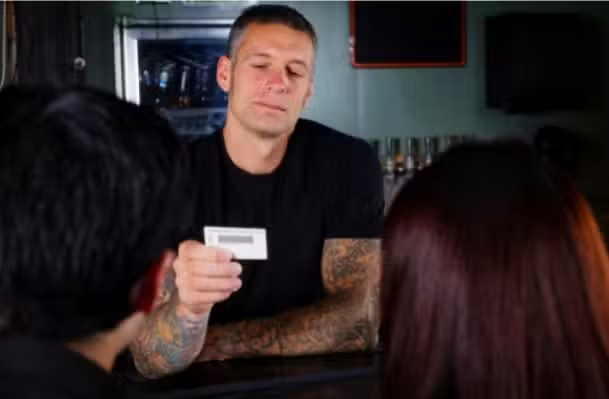
- How to prevent sales to minors, including ID verification techniques
- New York State alcohol laws, rules, and regulations specific to your role
- The legal concept of dram shop liability and what it means for you and your employer
- How alcohol affects the body blood alcohol content, impairment, and metabolism
- Practical intervention strategies for managing difficult situations professionally
- How to document incidents and protect yourself legally
The practical value is real. Servers who have completed ATAP training consistently report greater confidence in difficult customer interactions, a clearer understanding of their personal liability, and better relationships with management.
How Long Does NY ATAP Certification Take And Is It Worth It?
If there’s one thing that puts people off pursuing certifications, it’s the time commitment. The good news is straightforward: ATAP certification in New York is designed to be completed quickly. Through an approved online provider, the course typically takes approximately two hours to complete for most people. It’s entirely self-paced meaning you can work through it at your own speed, on your own schedule, and pause whenever life calls you away.
How to Get Certified: Step-by-Step
- Enroll online Sign up with an NYSLA-approved provider in minutes. No paperwork, no prerequisites, no waiting period.
- Complete the course modules Work through the self-paced material at your own speed. Most people finish in approximately three hours.
- Pass the final assessment Demonstrate your understanding of the material through a completion assessment included in the course.
- Download your certificate instantly Upon completion, download your New York ATAP certificate immediately. No waiting for mail or processing.
How Long Is the Certification Valid?
Once you’ve completed your New York ATAP course, your certification is valid for three years from the date of completion. After that, you’ll need to renew by completing the course again to maintain your certified status.
Is It Worth It?
By any reasonable measure, yes and emphatically so. A three-hour time investment and a modest course fee in exchange for a credential that is valid for three years, required by most employers, recognized statewide, and genuinely protective of your professional and personal liability. The cost of not having it in terms of employment opportunities, insurance exposure, and legal vulnerability is far higher than the cost of getting it.
ATAP vs. TIPS: What’s the Difference?
You may also have encountered the term TIPS certification in your research. TIPS (Training for Intervention ProcedureS) is one of several NYSLA-approved training providers operating under the ATAP framework. It’s a well-known brand, but it’s not the only or necessarily the best option.
|
TIPS Certification |
Serving Alcohol Inc. |
|
Large, investment-backed national training brand. NYSLA-approved but among the more expensive options on the market. Higher price point |
Employee-owned and operated. NYSLA-approved ATAP provider offering the same state-recognized credential at a fraction of the cost, with a USA-based support team. Starting at $12.50 |
The credentials issued by different NYSLA-approved ATAP providers are equivalent in the eyes of New York State. What matters is that the credential is current, issued by an NYSLA-approved provider, and verifiable not which specific approved school issued it.
For employers who require ATAP certification, any NYSLA-approved provider will do. The meaningful differences come down to price, course quality, support, and the specific focus of the curriculum on New York’s laws and regulations.
Part 3: The Specific Benefits for Bartenders
Bartenders occupy a unique position in the security ecosystem of a bar or nightclub. They have more sustained, close contact with guests than almost anyone else on staff. They are the ones who physically control the flow of alcohol. And they are often the first to sense when something is wrong.
Bartenders as the First Line of Defense
A bartender who understands their legal responsibilities and has practical training in recognizing intoxication is enormously valuable to any establishment. They are in a position to prevent problems that no amount of security muscle can fix after the fact. Once a guest has been over-served to the point of becoming belligerent or incapacitated, the damage is already done. A trained bartender stops it from reaching that point.
Building Confidence and Reducing Staff Stress
One of the most underappreciated benefits of proper training is its effect on staff morale and mental health. Working in a bar or nightclub can be an extraordinarily stressful job. The pace is relentless, the stakes are high, and difficult situations arise without warning. Staff who have not been trained often feel anxious, unsure of themselves, and resentful of the pressure they are under.
Training changes this. When a bartender knows exactly what to look for, what to say, and what to do, they approach their shift with confidence instead of anxiety. They feel supported by their employer. They are more engaged, more effective, and more likely to stay in the job which reduces turnover, one of the most expensive ongoing costs for any hospitality business.
Protecting Your Liquor License
A bartender who serves a minor or who continues serving a visibly intoxicated person puts the establishment’s liquor license at risk. Losing that license is a business-ending event. The liquor license is the heartbeat of a bar or nightclub without it, there is no business. The training investment that prevents a single serving violation more than pays for itself in the value of the license it protects.
Tips, Service Quality, and Reputation
A somewhat overlooked benefit of responsible beverage service training is the impact it has on service quality and customer satisfaction. Trained bartenders understand how to pace drinks for guests, how to suggest food and water alongside alcohol, and how to engage guests in a way that keeps them comfortable and enjoying themselves without pushing them toward overservice. The result is often better tips, better reviews, and a more loyal customer base.
Age Requirements for Serving Alcohol in New York
A quick note on who can legally serve and sell alcohol in New York State:
- The minimum age to serve alcohol in an on-premise establishment (bar, restaurant) in New York is 18 years old.
- The minimum age to sell alcohol in a retail environment (liquor or convenience store) is also 18 years old.
- Barbacks and bus staff in on-premise establishments may work from age 16, provided they are directly supervised by an employee who is 21 or older.
This means ATAP certification is accessible to workers entering the industry at 18. There’s no age-based barrier to taking the course you can enroll, complete your certification, and walk into your first hospitality job fully credentialed from day one.
Frequently Asked Questions (FAQs)
What is ATAP certification New York is it the same as a bartending license?
New York State doesn’t issue a formal bartending license. The ATAP certification the Alcohol Training Awareness Program credential issued by NYSLA-approved providers is what employers and industry professionals typically mean when they refer to a “bartending license” in New York. Completing an approved ATAP course is the standard path to meeting that expectation.
How long does ATAP certification take in New York?
For most people, the online course takes approximately three hours to complete. Because it’s fully self-paced, the actual elapsed time varies some move through the material more quickly, others take breaks and return. Once you finish, your certificate is available for immediate download.
Does ATAP certification expire in New York?
Yes. New York ATAP certification is valid for three years from your completion date. After three years, you’ll need to renew by retaking an approved course. Staying current with your certification is important both for employment eligibility and for insurance compliance purposes.
Can I take the ATAP course on my phone?
Yes. Quality NYSLA-approved providers offer fully mobile-friendly courses that work on smartphones, tablets, and computers. You don’t need special software just a device with internet access and a modern browser.
Who oversees alcohol licensing in New York?
The New York State Liquor Authority (NYSLA), headquartered at 84 Holland Avenue, Albany, NY 12208, is the state agency responsible for regulating alcohol manufacture, sale, and distribution across New York. Their main contact number is 518-474-3114, and their website at sla.ny.gov maintains a list of certified ATAP training providers.
Get Certified Before Your First Shift
The New York hospitality industry moves fast. Bars staff up quickly, restaurants need servers on short timelines, and event venues can’t afford to wait. Having your ATAP certification ready before you start your job search puts you in a meaningfully stronger position you become a candidate who can start immediately, fully compliant, with zero onboarding friction for your employer.
The investment is minimal. About three hours of your time. A modest course fee. In return, you get a three-year credential from an NYSLA-approved provider that signals professionalism, legal awareness, and responsibility to every employer in the state.
Whether you’re stepping into your first bartending role, pivoting to hospitality from another industry, or managing a team that needs to come into compliance ATAP certification is the right move. Start your course today and have your certificate in hand before the day is out.
Disclaimer: The information in this article is for general informational purposes only and is based on publicly available NYSLA guidance at the time of writing (May 2026). It does not constitute legal or regulatory advice. ATAP certification requirements, employer obligations, and alcohol service laws may vary by location and are subject to change. Always verify current requirements directly with the New York State Liquor Authority (sla.ny.gov) or a qualified legal professional before making any compliance-related decisions.