Table of Contents
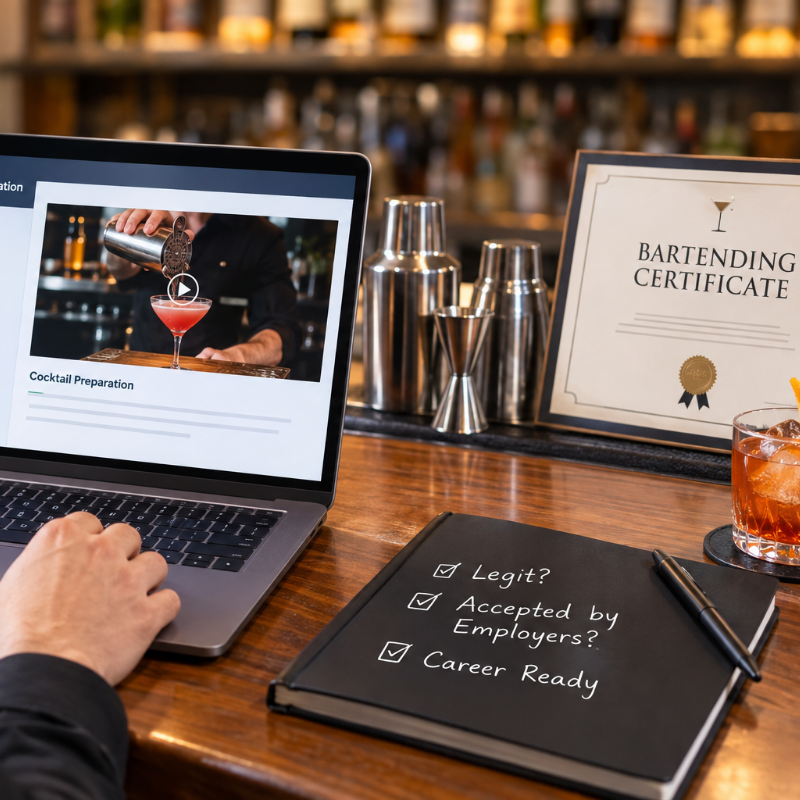
If you’re considering a career behind the bar, you’ve probably noticed that most alcohol server certification courses today are offered online. That naturally raises a common question. Is an online bartending license actually legitimate, and will employers accept it the same way they would a certificate earned in person?
The short answer is yes, as long as the course is properly state-approved. But there’s a lot of nuance behind that answer, and understanding it can save you time, money, and potential headaches when you’re applying for bartending or serving jobs. In this guide, we’ll break down how online certification works, what makes a course legitimate, and how platforms like Serving Alcohol meet employer and state-regulator standards.
What Is an “Online Bartending License,” Really?
First, a quick clarification: in most states, there isn’t a formal government-issued “bartending license” the way there’s a license for driving or practicing law. What people commonly call a bartending license is typically an alcohol server certification, sometimes known as:
- Responsible Beverage Service (RBS) certification
- TIPS certification
- Alcohol Awareness certification
- Alcohol seller/server permit
These certifications confirm that you’ve completed training on responsible alcohol service, including ID verification, recognizing intoxication, understanding legal drinking age laws, and knowing how to refuse service when necessary. Many states require this certification by law before you can legally serve alcohol, while others make it optional but strongly recommended and often required by individual employers regardless of state law.
Traditionally, this training was done in person through classroom-style sessions. Today, most certification providers, including Serving Alcohol, offer this training entirely online, allowing students to complete coursework at their own pace on a phone, tablet, or computer.
So, Is Online Certification Legit?
Yes, when the course is properly approved by the relevant state authority. Here’s what makes an online certification legitimate:
1. State Approval or Recognition
The most important factor is whether your state’s Alcoholic Beverage Control (ABC) agency or equivalent regulatory body approves the course. States that require alcohol server certification typically maintain a list of approved providers or set specific content standards that courses must follow. A legitimate online provider will clearly state which states its courses are approved for, and will keep that list updated as regulations change.
2. Comprehensive, Standards-Based Curriculum
Legitimate courses aren’t just quick quizzes. They cover real scenarios and legal standards, including checking identification for authenticity, recognizing signs of visible intoxication, understanding liability laws, and handling refusal of service professionally.
3. A Real Assessment
After completing the training material, legitimate courses require you to pass an exam that demonstrates your understanding before issuing a certificate. This isn’t just a formality it ensures the certification actually reflects competency, which is part of why employers and regulators accept it.
4. Verifiable Certification
A legitimate online certificate typically includes your name, the issuing organization, the state it applies to, the completion date, and an expiration date. Many providers, including Serving Alcohol, also offer digital verification or account access so employers can confirm a certificate’s authenticity if needed.
Do Employers Actually Accept Online Certifications?
Yes, in most cases. Online alcohol server certification has become the industry standard, not the exception. Bars, restaurants, hotels, catering companies, and event venues widely accept online certificates, as long as they come from a state-approved provider.
In fact, online certification often works better for both employers and employees because:
- It’s faster to complete, meaning new hires can get certified and start working sooner.
- It’s easier to schedule, since employees can complete training around their existing shifts rather than attending a fixed in-person class.
- It’s simple to verify, since digital certificates can be quickly shown, emailed, or reprinted when an employer or regulator requests them.
- It scales well for hiring, allowing restaurant groups, catering companies, and event staffing agencies to get multiple new hires certified quickly without coordinating in-person sessions.
That said, employer acceptance still depends heavily on state-specific validity. An online certificate that’s valid in one state may not automatically transfer to another state with different requirements. This is why it’s important to choose a course specifically designed for the state where you plan to work, which is exactly what Serving Alcohol is built to provide.
How to Make Sure Your Online Certification Will Be Accepted
If you want to avoid wasting time or money on a certificate that won’t actually help you get hired, keep these points in mind:
Check State-Specific Approval. Before enrolling in any course, confirm it’s approved for the state where you intend to work. Serving Alcohol organizes its courses by state, making it easy to choose the right training instead of guessing.
Ask Your Employer or Prospective Employer. If you’re applying for a specific job, it’s reasonable to ask the hiring manager which certifications they accept. Most established bars and restaurants know the major approved providers and can confirm quickly.
Avoid Extremely Cheap or Vague Providers. Be cautious of providers that don’t clearly state which states they’re approved for, or that seem to offer a certificate with no real coursework or assessment. A legitimate certification should include real training content and a test, not just a payment and instant download.
Look for Renewal and Support Features. A trustworthy provider will also support you after certification, offering renewal reminders, easy certificate re-access, and updated courses when laws change. This is part of what makes a platform genuinely reliable, not just a one-time transaction.
Why Online Certification Has Become the Preferred Standard
The shift toward online alcohol server certification isn’t just about convenience. It reflects broader changes in how hospitality businesses operate. Restaurants and bars often deal with high staff turnover, seasonal hiring surges, and last-minute scheduling needs. Online certification lets new hires get trained and legally ready to work much faster than traditional in-person classes ever could.
Additionally, digital certification makes recordkeeping easier for both employees and employers. Instead of keeping a physical paper certificate that can be lost or damaged, servers using platforms like Serving Alcohol can log in anytime to download, reprint, or share their certification whenever it’s needed, whether that’s for a new job, a temporary event, or a routine compliance check.
Common Myths About Online Bartending Licenses
Myth: Online certification is less rigorous than in-person training. In reality, state-approved online courses must meet the same content standards as in-person options. The delivery method changes, but the required knowledge and assessment standards do not.
Myth: Any online certificate works in any state. This is false. Certification validity is state-specific, which is why choosing a provider that clearly organizes courses by state, like Serving Alcohol, is so important.
Myth: Employers prefer in-person certification. Most employers today want valid, state-approved certification, whether completed online or in person. Given how common online training has become across the hospitality industry, employers are generally very comfortable accepting it.
Myth: Once certified, you’re set for life. As covered in other guides, most certifications expire after a set number of years and require renewal, another process made simple through trusted online platforms.
Final Thoughts
Online bartending licenses, or more accurately, online alcohol server certifications, are absolutely legitimate and widely accepted by employers, as long as they come from a properly state-approved provider. The key isn’t whether the training happens online or in person, but whether the course meets your state’s specific legal standards and includes real training content plus a genuine assessment.
For anyone looking to start or continue a career in bartending, choosing a reliable, state-specific platform makes all the difference. Serving Alcohol offers state-approved courses designed to meet the exact requirements employers and regulators expect, with fast online completion, instant certificate access, and ongoing support for renewals as your certification approaches expiration.
If you’re ready to get certified or want to confirm your current certification meets your state’s requirements, visit Serving Alcohol today and get started with a course built specifically for where you work.
Disclaimer: This article is for general informational purposes only and does not constitute legal advice. Requirements for alcohol server certification, including which providers and courses are recognized, vary by state and employer, and are subject to change. Always confirm current requirements directly through your state’s Alcoholic Beverage Control (ABC) agency or equivalent regulatory authority, or consult a qualified attorney for guidance specific to your situation. Serving Alcohol provides state-specific, up-to-date courses to help you stay compliant, but you should verify your state’s exact rules before relying on any information in this article.